

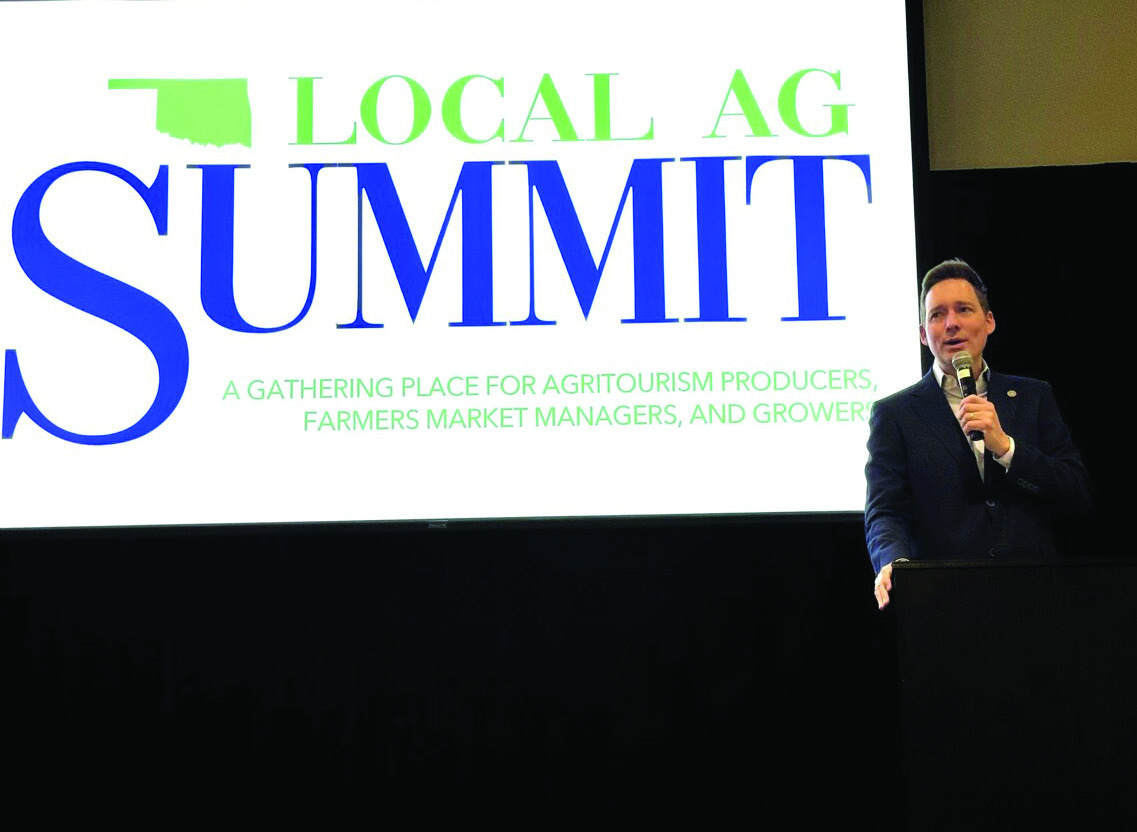
OKLAHOMA CITY – While attending the Oklahoma Local Ag Summit (OKLAS), Lt. Gov. Matt Pinnell said agriculture is currently experiencing more momentum than ever before.
Hosted by the Oklahoma Department of Agriculture, Food and Forestry and the Oklahoma Nutrition Information Education Project, Langston University, USDA and key stakeholders from agricultural, community and public health agencies, OKLAS brings together agritourism producers, farmers market managers and growers.
Now more than ever, consumers want to know where their food comes from.
“That is good for these small business owners and for our agritourism industry,” Pinnell said. “One of the more popular tourist attractions that people are looking for today is something that the y can do on a fa rm or ranch.”
Politicians should understand that this curiosity will onl y expand and that more of the next g enerations will seek agricultural products and choose to live in farming communities. “That is going to be a revolution in this country in future decades,” he predicted.
“Agriculture is still the backbone of the state of Okl ahoma with oil and gas and a few other industries. We are No. 4 in the country regarding the number of farms. That is good, but we need a whole lot more to feed the world.”
He encouraged the development of smaller gardening operations as well, saying that it doesn’t have to be 10,000 acres to constitute a farm. He also touted Oklahoma’s uniqueness and popularity as a tourism state.
Oklahoma promotes Americana, tourism “We have the new indoor waterpark, OKANA, thanks to the Chickasaw Nation. We have an advantage that other states don’t have, and that is our 39 tribes – the Native American experience that you can get here. I would add the cowboy – the Code of the West experience that you can get here, too. That Americana experience you get when you throw in Route 66 and the Chisolm Trail; if you want to see America, you’ve got to see Oklahoma. That is really the message that we have driven from our tourism industry, and it sells really well.”
Looking forward, Pinnell said there are big things in the pi peline. Next year is the Route 66 Centennial, so the state is in vesting millions into developing the Route 66 communities to make them more appealing to tourists to increase revenue in small towns.
“That is the most famous road in the world, and we have more miles of it than any other state in the country,” he said. “ That is a big part of my agenda this year.”
Additionally, the state is w orking on renovating the Oklahoma Music Hall of Fame in Muskogee to take better advantage of its musical heritage and history.
“We are going to turn it in to the iconic museum that it should be to really be a draw for tourists,” Pinnell said.
Special events equal revenue Regarding special events such as the recently wrapped up Cattlemen’s Congress, Pinnell said that economic impacts amount to millions through additional commerce at hotels and restaurants. He noted that many communities have added to and upgraded their expo centers and exhibition barns which draw more events and revenue.
“There are so many of those shows around the country,” he said. Oklahoma acquired “a few shows during COVID – a big a g show from Pennsylvania and Cattlemen’s Congress from Colorado. We love those kinds of stories as well, because when they show up here in Oklahoma – we hear it from attendees – they love being in Oklahoma because they know that we support agriculture here, and we are going to continue to support it.”