

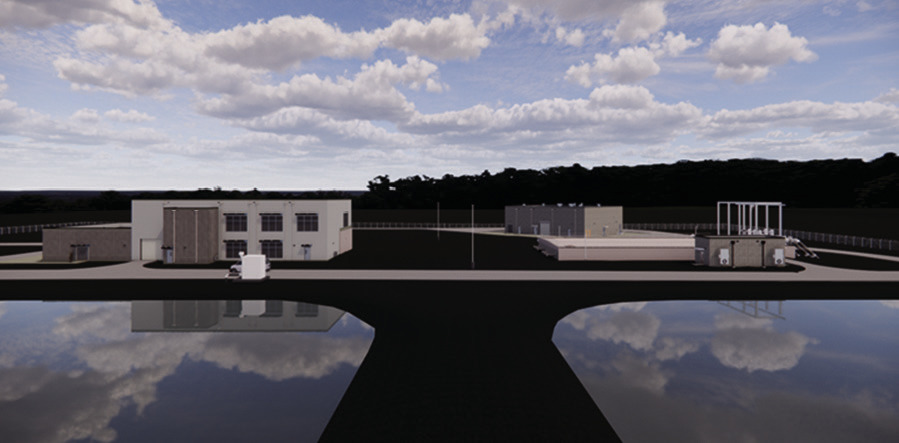
CHICKASHA – Freese & Nichols engineers and consultants expect to complete their design of Chickasha’s new water treatment plant in July, the City Council was told on Feb. 17.
F&N will submit their design for permits to the state Department of Environmental Quality in July, and bidding will occur between August and October, Professional Engineer Jason Cocklin said. Construction of the new facility is expected to start in October and will take approximately two years to complete, he predicted.
City officials are still negotiating for land on which the new treatment plant will be located, Mayor Zach Grayson told Southwest Ledger on Feb. 18.
The treatment plant envisioned by the Chickasha Municipal Authority will be capable of producing up to 6 million g allons of potable water daily, with the ability to be expanded to 8 mgd. Production of 6 mgd “should get you out to the horizon, to about 2060-70,” Cocklin told the council last year.
The new plant’s treatment process will include pre-treatment, clarification, filtration and disinfection, the CMA said. The plant “will have full back-up generation and redundancy,” Cocklin said.
Councilman Oscar Nelson wondered whether the new plant would treat raw water from Lake Chickasha.
“We did look at that,” Cocklin said, describing water in Lake Chickasha as “pretty complex.” Mixing water from Lake Chickasha with water from Fort Cobb Reservoir “is not favorable,” Cocklin said, “because Lake Chickasha water is ‘hard’ and contains gypsum and a high level of dissolved solids.” It would be diff icult to “get enough treated water from Fort Cobb to offset that.”
“We need as many options as possible, because we’re banking on that for the future,” Councilman Kelly Boyd said.
F&N engineers will send City Manager Jim Crosby “some options,” Cocklin said.
“All water can be treated,” Crosby told the Ledger. “Sewage is being treated for reuse, and desalinization makes water from the ocean drinkable.”
Raw water from Lake Chickasha “can be treated, it’s just a little more difficult” and would be “more expensive because it’s ‘hard’ water,” Crosby acknowledged. “With pretreatment, we think it could be diluted enough to mix with water we get from Fort Cobb Reservoir.”
Furthermore, he said, “We don’t need water from Lake Chickasha immediately. One study I’ve seen shows that we won’t need an additional source of water for another 25 years.”
Meanwhile, Crosby continued, “We’re preparing for the future by raising the level of Lake Chickasha. That doesn’t happen overnight. It depends on rainfall. It will probably take several years,” perhaps a decade, to achieve the goal of elevating the lake by 10 feet, he said.
In addition, “We have to fix the dam first and close the opening in the spillway,” Crosby said.
The road atop the dam needs some attention, the earthen dam has some eroded areas, and more trees will have to be cleared from the vicinity of the emergency spillway. The north side of the dam in the area of the spillway has been cleared “but not on the south side,” Crosby said. “It’ll be an easy fix” but will take some time to accomplish.
“This is a long-term solution,” Crosby said in December. The Oklahoma Water Resources Board “has given us five to seven years to fix the dam.”
OWRB records indicate the Lake Chickasha dam is 57 feet tall and 3,340 feet long.
Existing annual lease agreements for camping sites at Lake Chickasha will not be renewed, and all current lake lease agreements will be terminated in six months, Crosby announced in December. The City of Chickasha intends to raise the lake level in order to use the reservoir as an additional water source, he explained.
City officials have no intention of “kicking anybody off their lease” in six months, Mayor Zach Grayson told Southwest Ledger. More likely the leases will be renewed month-to-month “until the need arises to clear the land,” he said. “All current lake lease agreements shall terminate on June 30, 2025,” leaseholders were informed in a letter from City Hall.
As Chickasha grows, “We will not receive any more water rights from our present source,” which is Fort Cobb Reservoir, Crosby said during a city council meeting Dec. 16. In fact, “I think our water rights will be reduced” by the Fort Cobb Master Conservancy District, Crosby said. Consequently, “Our best and only [alternative] source is water from Lake Chickasha.”
Chickasha advised to find alternative source of water FCMCD “wants us to find an alternative source of water” to supplement Chickasha’s withdrawals from Fort Cobb Lake, former mayor Chris Mosley told the Ledger last year.
Chickasha’s contract with the FCMCD allows the municipality to draw up to 5,125 acrefeet of water (almost 1.67 billion gallons) per year, Office Manager Ginger Abbott told the Ledger. The city’s water consumption totaled 1.09 billion gallons in calendar year 2022 and again in 2023, Chickasha Municipal Authority records reflect.
Chickasha receives all of its water from the Fort Cobb lake approximately 35 miles northwest in Caddo County. The lake water is conveyed to Chickasha’s water treatment plant on Genevieve Street through a concrete asbestos pipeline.
Chickasha’s existing water treatment plant, which is at least 60-plus and perhaps 70-plus years old, is incapable of adequately treating water from Lake Chickasha.
The treatment plant was designed to process 6 million gallons of potable water daily, but now its “functional capacity” is 4.2 mil lion gallons per day to serve the 16,500 residents of Chickasha and the nearby community of Norge, former City Manager Keith Johnson said previously.
1.25% sales tax to finance new treatment plant A loan of up to $72 million to finance construction of a new, larger water treatment plant in Chickasha was approved in July 2023 by the Oklahoma Water Resources Board.
After subtracting fees for the project bond counsel, financial adviser and local counsel, the trustee bank, and the OWRB’s costs of issuance, approximately $69 million will be available to spend on building the new treatment plant. The loan proceeds will be coupled with $5 million in existing capital outlay funds, city officials said.
The loan provisions decree that the debt will be retired over a maximum period of 31 years.
Chickasha residents voted overwhelmingly in a special election Aug. 8, 2023, on a proposal to renew and increase a sales tax that’s dedicated to capital improvements.
Local voters approved a permanent 1.25% (one and one-quarter cent) sales tax that went into effect Jan. 1, 2024, replacing the city’s previous 0.75% (three-quarters of a cent) Capital Improvement Project sales tax that expired Dec. 31, 2023. Passage of the new levy resulted in a net increase of half a cent in the sales tax, boosting the overall city sales tax from 3.75% to 4.25% (four and one-quarter cents per dollar). Including the state’s and Grady County’s levies, the total sales tax bite in Chickasha is 9.5 cents per dollar.
Revenue from the new levy is dedicated exclusively to capital improvements.
CMA, USWS have amended contract Because a new water treatment plant will be built, the Chickasha Municipal Authority and U.S. Water Services Corporation have amended their contract to provide for a “discretionary right to terminate” their Water and Wastewater Operations Services Agreement.
An amendment, the fourth since July 1, 2015, authorizes the city to sever the arrangement as of Jan. 1, 2026, by giving U.S. Water Utility Group (USWUG) 120 days’ notice. However, the CMA “may not exercise” its right of termination, and may not provide USWUG with a termination notice, “prior to Jan. 1, 2026.”
CMA approved the amendment on Jan. 6, 2025.