

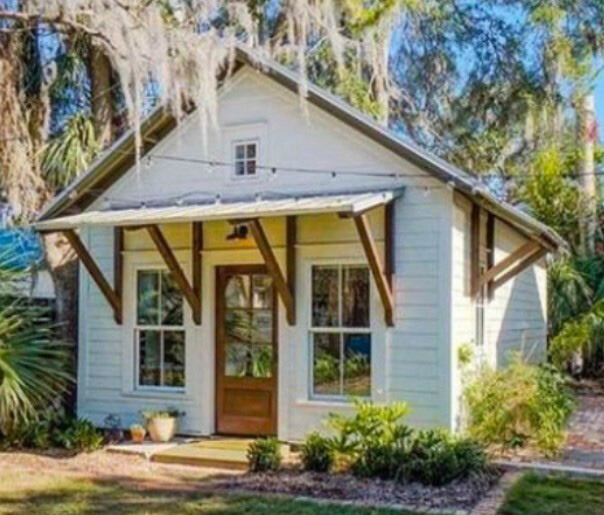
CHICKASHA – Eight tiny homes will be built where an equal number of larger, decrepit residential structures at Sixth Street and Colorado Avenue were demolished earlier this year.
The City Council approved the Planned Unit Development proposed by David Lewis, founder and president of Earthly Dwellings Inc., and Bill Flores, vice president of the company.
They propose to construct eight 400-squarefoot, one-bedroom, detached cottages on one parcel of land which previously supported eight rental houses that were dilapidated “and a nuisance to the neighbors and the city,” the Community Development Department reported.
The rental houses “served their purpose, but after 105 years they were a fire hazard and a place of criminality,” Flores said.
“There was a lot of drug traffic in that area” before the aged houses were torn down March 10, Councilman Clark Southard said.
Earthly Dwellings is a faith-based 501(c)(3) nonprofit developer “with a vision to provide realistic housing solutions.” Lewis and Flores said they partner with local churches, nonprofits, local government, and businesses “that wish to support our mission.”
“We are not accepting federal money,” Flores said. “Too many strings attached with it.”
During a Rotary Club program last November, Lewis said he grew up in Chickasha, left for several years and then returned. Flores said he came to Chickasha after 20 years of military service. They said they were “led to create Earthly Dwellings to fill a need for safe housing and community for people in need.”
The now-vacant land at the northeast corner of Sixth and Colorado is zoned C2 General Commercial and is owned by Earthly Dwellings. “We bought that property with donated money,” Flores said.
The plan is to have eight unrelated persons living on the property. No more than one person will be housed in each cottage, and no couples or adults with children will be allowed to live in the houses because of occupancy code regulations, Community Development Director Rachel Bernish said.
Limiting occupancy to one person per house “is troublesome,” Councilman Charlie Burruss said.
“There are plenty of single people in town – students attending the University of Science and Arts of Oklahoma, for example – who’d spend $700 per month for housing,” Lewis said.
Research has shown that 13.5% of Chickasha homeowners and 41% of local renters spend more than 30% of their income on housing expenses such as monthly rent or a mortgage, utilities and insurance. “Who becomes responsible for enforcement of occupancy?” Councilwoman Kea Ginn asked.
Earthly Dwellings “will make sure residents adhere to their leases,” Flores replied.
The units will have shared green spaces and walkways. The design “promotes community interaction while ensuring security,” Lewis wrote.
The development will be named “iTy Community” because of “its visibility from the main road through Chickasha,” Lewis said. It also will offer residents “walkability to essential services such as a grocery store, library, local churches, YMCA, dining establishments, and City Hall,” he continued. In addition, it will be designed for residents “who either do not own or choose not to use automobiles…” Although no bus stops are planned “within or for” the PUD, the Washita Valley Transit System “makes frequent stops” at the Williams Foods grocery store next door to the Earthly Dwellings property, the developers said.
Officials approve parking variance The site will have eight parking spaces in the off-alley paved parking area (one per resident), and two spaces for handicapped parking. Visitors will use “the eight public spaces on the west side along Sixth Street, as available,” the PUD plan relates. Additional parking spaces are available on the other side of the street, too, Lewis said. Sixth is “a wide street,” said Flores.
Chickasha’s Planning Commission stamped its seal of approval on the proposal Aug. 12 even though the development doesn’t have two parking spaces per cottage as mandated by the City Code.
Bernish – in one of her last official acts before leaving after Sept. 12 to become an assistant city manager at Stillwater – recommended the City Council require the developers to comply with the city code requirement of two parking spaces per house, or 16 parking spaces for the eight tiny houses. Visitors parking in the street might “create a public hazard which would then have to be addressed by the Police Department,” she said.
In response to a question, Bernish also said, “No other developer has been allowed a variance for just one vehicle per residence.”
Southard, though, argued that with occupancy restricted to one person per tiny house, one parking space per cottage plus two reserved for handicapped parking should be sufficient.
And Lewis added, “We don’t want to build a parking lot” because the cost would be prohibitive.
Developers of the proposed eight small houses at Sixth and Colorado say they intend to build what is recommended in the “Onward Chickasha” Comprehensive Plan that the City Council adopted March 17.
The introduction to the 316-page document recommends housing policies that “should cover a wide range of essentials … including diverse housing options, affordability, safe and high-quality homes…” Local residents have “expressed a clear desire for diverse, high-quality housing options that preserve the city’s historic character while meeting modern needs,” the Comprehensive Plan relates in Goal 1.
“This is the first action I have seen that does more than just talk about this issue,” Mayor Zach Grayson said. “It’s a heckuva lot more than we’ve seen before.”
After 40 minutes of discussion, the council voted 7-1 to approve the proposed development with 10 parking spaces instead of 16. Burruss cast the “no” vote.
“We’re ready to start work,” said Flores.
However, “We have not received the engineering plans yet,” Bernish said.
Development would have small footprint While city regulations authorize 6,000 square feet per residence, Earthly Dwellings would have eight cottage homes – each comprising approximately 400 square feet – on an aggregate site area of 20,611 square feet.
The area under-roof has been reduced from 6,312 square feet to 3,200 to 3,600 square feet, “thereby enhancing soil water absorption and improving overall drainage,” the developers wrote.
The PUD would meet the setback requirement of 25 feet from the street, 15 feet from neighbors’ fences.
Each of the houses would be separated by at least 10 feet of space “for fire safety reasons.” A f ire hydrant is located at the corner of the property; the fire plug was tested on March 7 and the Fire Department deemed it to be “in good working order.”
No storm shelter would be constructed for the residents. The property is not located in a flood zone and has adequate water drainage, records reflect.
Water meters will be installed for each of the eight houses.
The property has two connections to the municipal sanitary sewer system at the east alley right-of-way between Fifth and Sixth streets. An additional sewer tap will be installed for each cottage in compliance with the city code, “ensuring the mitigation of any sewage backup.”
The cottages will be all-electric. Natural-gas service has been discontinued “and will not be available at this development,” Lewis and Flores reported. No telephone service will be provided, either.
Common areas will be maintained by the developers. Those duties include mowing, edging and general upkeep of lawns and open spaces; trash and debris removal from all shared spaces; upkeep of plants, trees and shrubs; and maintenance and repair of perimeter fencing and walkways.
Sidewalks along the street sides will be 5 feet wide, and sidewalks to the front door of each cottage will be 4 feet wide.
The development will be enclosed with a fence. A 6-foot privacy fence will be installed on the north and east sides. In front of the southernmost cottage the fence height will be reduced to 4 feet and transition into a 4-foot picket fence with 50% visibility along Colorado Avenue and Sixth Street.
The cottages will be accessed via gated entrances on three sides of the property, Lewis said.
A communal dumpster for waste collection will be placed in the alleyway adjacent to the parking lot, enclosed on three sides, “thereby removing the clutter caused by individual trash containers.” The dumpster will be serviced regularly by a contracted waste hauler.
Lewis said maintenance activities will be financed through rental income.