

OKLAHOMA CITY – The newly announced Project Clydesdale data center in Tulsa is projected to use 6.1 million gallons of water per day. In a year, the data center will use 2.2 billion gallons of water, making it the second-largest water consumer served by the City of Tulsa Water and Sewer Department.
More data centers are being built in Oklahoma, but concerns about water and energy usage for cooling the equipment – along with questions about the actual benefits data centers bring to communities – is growing, too.
State Rep. Amanda Clinton, D-Tulsa, said she became interested in learning about data centers in Oklahoma after reading about Project Anthem – another data center that has been approved by the City of Tulsa. Clinton put together an interim study on data centers to try to understand the impact on Oklahoma’s water resources and power grid.
“Data centers are an increasingly significant part of Oklahoma’s economy and infrastructure. But this industry has experienced unprecedented growth and is also poorly understood by many Oklahomans,” Clinton said. “In short, data centers power our everyday lives and fuel our modern conveniences. We all enjoy streaming our favorite shows on demand, we can store hundreds of thousands of files on the cloud, and artificial intelligence is making many of our jobs and daily tasks more manageable. As demand for these conveniences increases, so does the need for data centers.”
Clinton provided members of the House of Representatives’ Utilities Committee some testimony from Tulsa- based Public Service Company of Oklahoma, which serves 575,800 customers (residential, commercial, industrial, and “other”) in 232 cities and towns in eastern and southwestern Oklahoma.
In testimony before the Oklahoma Corporation Commission, PSO said that without increasing power generation, the utility will be unable to meet the electrical demand of new commercial and industrial consumers moving into its service area.
In their testimony, PSO said that a new agreement with a customer will require more than 1,000 megawatts. Previously, the highest load contract was for 130 megawatts. Clinton said that if the Corporation Commission approves new PSO generation projects, a typical residential customer will experience an average rate increase of $10 per month.
John Woods from the Oklahoma Department of Commerce discussed the creation of jobs in Oklahoma due to data centers. There are 36 data centers in the state and the Department of Commerce knows about plans for six more being built, he said. Data centers generally use contracted labor and offer full-time employment to 9.2 people, on average, in Oklahoma.
“Finding reliable data on how many permanent, local jobs hyperscalers create was difficult, and I was surprised to hear the Oklahoma Department of Commerce estimate that hyperscale data centers may create fewer than 10 jobs per structure on their campus,” Clinton said after the interim study.
“At the same time, the capital investment is undeniable. Several companies in Tulsa are growing their businesses by building data centers or supplying the equipment that fuels this technology, and that is good news for our region. It just shows how complex this industry is, and how important it is for local leaders to fully vet these projects.”
Yohanes Sugeng, Engineering and Planning Division chief from the Oklahoma Water Resources Board, discussed water scarcity in Oklahoma. The Water Board manages water right permits. Several regions in Oklahoma do not have sufficient subterranean groundwater left to be siphoned out for new developments like data centers, Sugeng related.
Madison Miller, deputy executive director of the Oklahoma Department of Environmental Quality, explained the permitting processes data centers go through to obtain and dump water and about the permits needed to operate generators that could pollute the air.
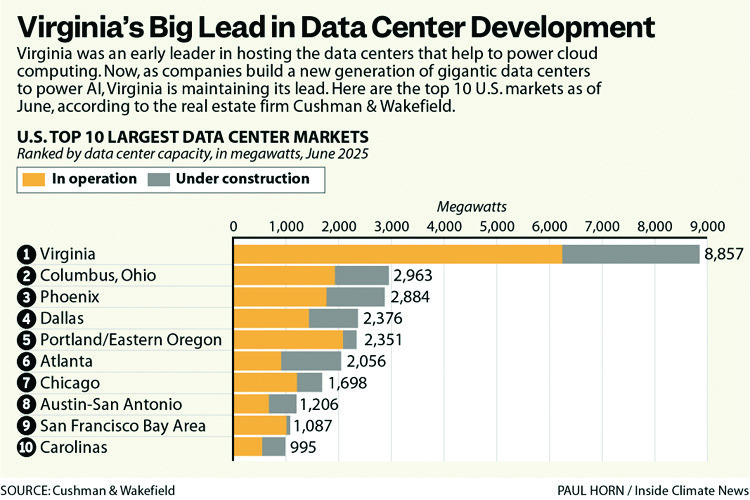
Mark Gribbon and Scarlett Saunders from the Virginia Joint Legislative Audit and Review Commission related how that state has handled data center projects. Virginia has the largest data center market in the world.
Inside Climate News reported that Virginia – particularly northern Virginia’s suburban counties outside of Washington, D.C. – “leads the world” in development of data centers that “house the computers processing the internet and artificial intelligence.” Virginia outpaces other top markets such as Beijing, China, ICN reported.
Gribbon said data centers create the most jobs during construction, but when they are fully functional they may operate with 10 or fewer employees. Data centers can generate significant tax revenues for municipalities and the state. But because there is a state data centers sales tax exemption, Virginia does not receive a net positive in tax revenue from them.
In Virginia, anxiety has been expressed about data centers being built near residential areas. Gribbon said issues can be addressed through improved local zoning and planning, although decisions are ultimately made by local elected officials.
Clinton said the study showed her that these developments are often in the hands of local elected leaders who need to properly vet these projects to protect their constituents.