

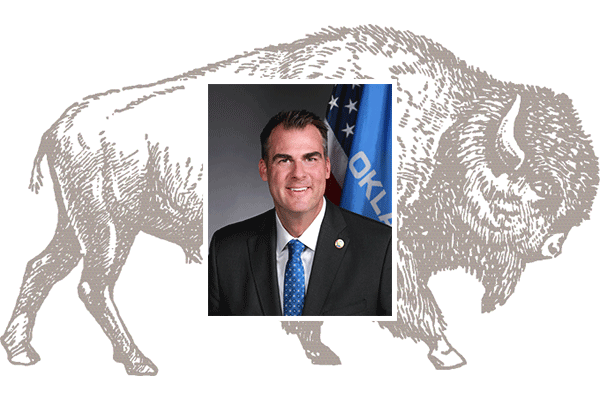
DUNCAN — The U.S. Supreme Court’s ruling that much of eastern Oklahoma is still tribal land could spell trouble for the state, Gov. Kevin Stitt said Wednesday.
“This creates tremendous uncertainty in our state,” he said. “It really threatens Oklahoma’s sovereignty.”
Stitt spoke about the high court’s 2020 decision in McGirt v. Oklahoma during the Duncan Rotary Club’s meeting at the Simmons Center in Duncan.
McGirt v. Oklahoma focused on whether the state could prosecute Jimcy McGirt, a member of the Muscogee (Creek) Nation, for sex crimes he had committed within the Nation’s historical boundaries. In a 5-4 decision, the Supreme Court ruled that Congress had never disestablished the Creek Nation reservation in eastern Oklahoma, so a large portion of that part of the state is still tribal land.
The court’s decision means that Oklahoma cannot legally prosecute a Creek citizen for criminal conduct in state court. Instead, those cases are subject to federal or tribal jurisdiction.
Stitt said he was pleased with the Oklahoma Court of Criminal Appeals’ recent ruling that the McGirt decision did not apply to criminal convictions retroactively.
“That unanimous decision was great on retroactivity for victims, making sure they didn’t have to relive any kind of court case again, have to testify again,” he said.
But Stitt said the McGirt decision has led Oklahoma tribes to challenge the state’s authority in other areas, including taxes. He said one of the five tribes, which he did not name, has announced it has the authority to tax oil and gas producers within the reservation’s boundaries.
“I get it,” Stitt said. “If the reservation still exists, it’s no longer Oklahoma. It’s actually a reservation, and they’re going to enforce their laws. They’re going to try to maximize revenue.”
In December 2020, the Seminole Nation of Oklahoma sent letters to oil and gas producers demanding tax payments. according to a Jan. 20, 2021, statement from then-Attorney General Mike Hunter. The letters were sent to producers who were not members of the Nation and were not operating on Seminole trust land or restricted Indian allotments.
The tribe later clarified its position, saying its taxing authority extended only to oil and gas producers operating on Seminole Nation trust land or restricted allotments, not to land belonging to non-Native Americans, according to Hunter’s statement.
Hunter’s successor, Attorney General John O’Connor, recently asked the Supreme Court to either overturn or limit the McGirt decision.